Tot-University



CHILD DEVELOPMENT
Reading
Whenever possible, oral language is used as a major avenue to help each child develop an ability to use language for complex communication. Pre-reading play and all school activities are integrated through literature. Literature is integrated through a variety of methods, including story telling, books, puppets, flannel boards, and drama. To help us facilitate this process, we ask parents to help us by reading to their children at home. In addition to opening virtually limitless doors to pleasure and knowledge, daily exposure to the rich patterns of language and story - through hearing stories read aloud - effect greater success in reading in later school years. Reading is a lifelong learning experience, serving as a key to wonderful opportunities and a springboard to all other areas of study and endeavor.
Gross Motor Skills
Research has demonstrated a direct correlation between reading ability and gross motor development. Gross motor activities involve the development and coordination of the larger muscles. Opportunities to develop large muscles are provided through climbing, walking, running, cycling, throwing balls, sweeping, dusting, mopping, passing in a narrow space, and large block play.
Fine Motor Skills
Fine motor skill activities will always be available, but are not pushed on a child. Experiences of choice with play dough, paper, pens, pencils, peg boards, puzzles, buttoning, zipping, cutting, screwing on and unscrewing jar lids, peeling fruit, sewing, skipping, and hopping all provide for the development of fine motor skills, which continue developing into the primary years of grade school. A developing child will desire to engage in fine motor activities as they are allowed the freedom to choose to be or not to be involved in these, developing a “built-in desire” without pressure from others. Forcing fine motor activities on a child too early can lead to difficulties in later years, and is to be avoided.
LEARNING
In Every Activity at Preschool children learn from every activity they experience. Here are some examples of how a child learns in every activity we conduct at the preschool. We teach our students:
Circle Time and Group Time
- Learns to share and be responsible to others.
- Increases self-confidence and self-image by participating in a group setting.
- Learns to take turns (patience).
- Improves listening skills.
- Learns to follow directions.
- Learns that thoughts, ideas, and feelings can be expressed aloud.
- Learns problem solving.
- Builds vocabulary.
- Learns that what others say is important, too.
Art Center
- Learns individual creative expression.
- Learns to express feelings about family and friends.
- Experiences colors, shapes, writing, and cutting tools.
- Learns to use small muscles.
- Learns to tell about his creation.
Philosophy: the process and experience of the creation outweighs the end result
Dramatic Play
- Learns to develop socially in relating to others.
- Learns from role playing and how to role play.
- Learns to express self in ways he cannot at home. Learning Centers
- Discovery, Language, Science, and Readiness
- Learns to make choices.
- Expands learning of specific information.
- Learns to complete tasks.
- Learns to think and problem solve.
- Enlarges his vocabulary.
- Builds feelings of self-confidence and competence.
- Discovers and learns through direct, individual experience.
Free Play
- Learns to use and care for materials and equipment.
- Develops physical and motor skills (coordination and manipulation).
- Learns shapes, counting, building, and matching through blocks.
- Learns to share and play together.
Dramatic Play
- Learns to develop socially in relating to others.
- Learns from role playing and how to role play.
- Learns to express self in ways he cannot at home.
The different centers provide quiet areas for the child who wants to learn and experience individually, as well as group areas for the child who wants to explore collaboratively.
SPIRITUAL GROWTH
Adult staff members model behaviors of love, peace, patience, kindness, forgiveness, gentleness, joy, and self-control to all.
All children experience God’s love through stories, songs, and prayers, reaffirming their self-worth as a special creation of God.
Additionally, all children become aware of the many blessings from the Lord (such as trees, flowers, family, friends, food, toys, teachers, etc.).
Preschool Menu
Riverside Christian
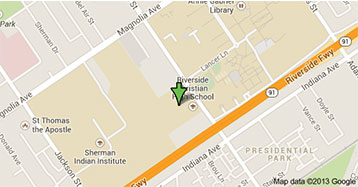
3532 Monroe Street
Riverside, CA 92504
Main: (951) 687-0077
Fax: (951) 687-3340
Office Hours
7:30 AM - 3:30 PM
Summer Hours
9:00 AM - 2:00 PM
Contact Us